
Table of Contents
Bali has a reputation for endless sunshine, but anyone who has arrived in January expecting blue skies and found themselves watching a tropical downpour from the villa terrace knows the reality is more nuanced. For groups and families planning a luxury villa stay in Seminyak, understanding Bali’s weather patterns is not just helpful, it’s essential. The right timing can mean the difference between slow mornings by the pool and scrambling to rearrange plans around afternoon storms. This guide covers everything you need to know, from dry and wet season trade-offs to timing your trip around school holidays and making the most of your villa no matter what the forecast says.
- Understanding Bali’s weather patterns
- Dry season vs. wet season: What to expect for villa living
- When to visit: Timing tips for families and groups
- Maximizing your villa stay: Weather-smart planning strategies
- The surprising truth about Bali villa weather: What most travelers miss
- Discover your perfect Seminyak villa
- Frequently asked questions
Key Takeaways
| Point | Details |
|---|---|
| Dry and wet seasons | Bali’s weather varies drastically between the dry (May-Oct) and wet (Nov-Apr) seasons, impacting your villa experience. |
| Seminyak is villa-friendly | Southern Seminyak enjoys less rainfall and more consistent sunshine than much of Bali—ideal for luxury villa stays. |
| Smart timing matters | Traveling during shoulder months or early/late dry season balances good weather, rates, and crowd levels. |
| Plan around daily weather | Scheduling outdoor activities in the mornings and using villa indoor spaces in the afternoons can maximize fun even in the rainy season. |
Understanding Bali’s Weather Patterns
Seminyak sits in the Badung regency on Bali’s southern coast, and its climate follows a straightforward tropical rhythm. There are two seasons: a dry season and a wet season. That’s it. No spring, no autumn, no gradual temperature drop. What changes between the seasons is mainly rainfall and humidity, not temperature.
Year-round average highs in Seminyak sit between 26°C and 32°C, with humidity typically ranging from 75% to 85%. During the dry season, humidity drops closer to the lower end of that range, which makes a noticeable difference when you’re spending long days outdoors or lounging by a private pool. The heat feels more comfortable, and evenings are genuinely pleasant.
What surprises many first-time visitors is how consistent the temperature stays across the whole year. You won’t need a jacket in June and you won’t be sweating through December any more than you would in August. The key variable is rain.
Seminyak’s average monthly climate at a glance:
| Month | Avg high (°C) | Rainfall (mm) | Season |
|---|---|---|---|
| January | 30 | 320 | Wet |
| February | 30 | 290 | Wet |
| March | 31 | 230 | Wet |
| April | 31 | 120 | Transition |
| May | 31 | 80 | Dry |
| June | 30 | 55 | Dry |
| July | 29 | 40 | Dry |
| August | 29 | 35 | Dry |
| September | 30 | 45 | Dry |
| October | 31 | 90 | Transition |
| November | 31 | 160 | Wet |
| December | 30 | 300 | Wet |
Southern Seminyak also benefits from a geographic advantage. Compared to central and northern Bali, the southern coast receives less rainfall overall and dries out faster between showers. For villa guests who want to use outdoor spaces, this matters. A rainy afternoon in Seminyak is often a passing shower, while the same weather system can mean an all-day soak further inland.
- Temperatures stay warm year-round, averaging 26°C to 32°C
- Humidity is lower and more comfortable during the dry season
- Southern Seminyak is drier than central or northern Bali
- Rain is the primary variable, not heat
Pro Tip: If you’re traveling with kids or planning a lot of pool and beach time, use the temperature consistency to your advantage. The weather won’t be dramatically hotter or cooler in any given month, so your decision really comes down to how much rain you’re willing to work around. Check out the family travel tips on the Casa Brio blog for more practical planning advice.
Dry Season vs. Wet Season: What to Expect for Bali Villa Living
Now that you understand the overall climate, let’s look at the real-world experience of villa living across Bali’s contrasting seasons.

The Dry Season (May to October)
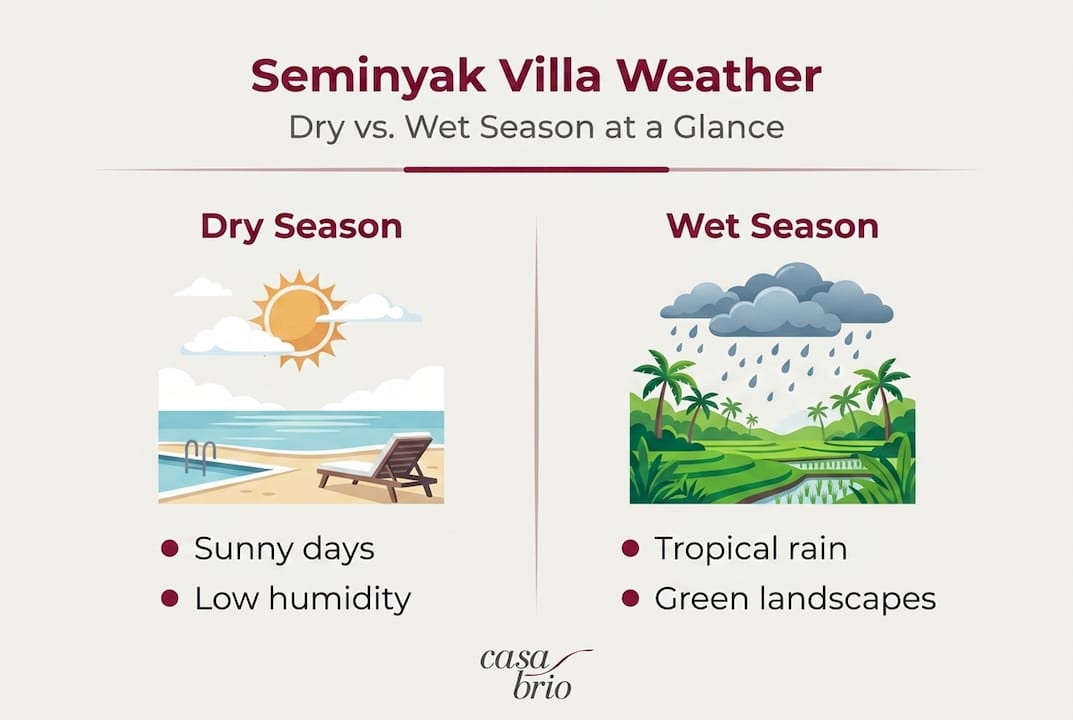
This is what most travelers picture when they think of Bali. July and August see the lowest rainfall of the year, often just 35 to 40mm for the entire month. Days are reliably clear, the pool is inviting from morning to evening, and outdoor dining feels effortless. This is the window that works best for families with school-age children, particularly for Australian and European travelers whose summer holidays align neatly with Bali’s driest months.
The trade-off is predictable. Peak dry season means peak prices and peak crowds. Seminyak’s beach clubs, restaurants, and boutique shops are busiest in July and August. Villa availability tightens, and rates reflect the demand. Booking three to six months in advance is standard practice for groups wanting a well-located property.
The Wet Season (November to April)
This period has a more complex reputation than it deserves. December and January see the heaviest rainfall, typically 300 to 350mm per month, but the rain usually arrives in concentrated afternoon bursts rather than all-day downpours. Mornings are often clear and warm, which gives groups plenty of time for beach walks, spa visits, and outdoor breakfasts before the clouds roll in.
“The wet season in Seminyak isn’t a reason to stay home. It’s a reason to plan your days differently.”
Villa rates drop noticeably during the wet season, which makes it an attractive option for groups and extended families who want more space and privacy without the peak-season price tag. The landscape is also genuinely beautiful, lush and green in a way that the dry season simply can’t match.
Dry vs. wet season comparison for villa guests:
| Factor | Dry season (May-Oct) | Wet season (Nov-Apr) |
|---|---|---|
| Pool use | Ideal daily | Good mornings, variable afternoons |
| Villa rates | Higher | Lower, better value |
| Crowds | Busy | Quieter |
| Outdoor dining | Reliable | Plan for early evenings |
| Landscapes | Dry, golden | Lush, green |
| Booking lead time | 3-6 months | 4-8 weeks |
For Singaporean and Hong Kong travelers, the wet season actually aligns with the Chinese New Year holiday window, when Bali’s lush green season and quieter atmosphere can feel like a welcome contrast to the bustle back home. European travelers with flexible dates often find that May, June, and September offer the best of both worlds: dry weather, moderate crowds, and rates that haven’t yet hit peak-season levels.
Pro Tip: If your group is visiting during the transition months of April or October, build some flexibility into your daily plans. Rainfall patterns during these months can be unpredictable, with occasional afternoon showers even as the season shifts. A villa with generous covered outdoor areas makes these transitions much easier to enjoy. Explore villa layouts for groups to see what covered and indoor-outdoor spaces look like in practice.
When to Visit: Timing Tips for Families and Groups
Having explored Bali’s weather patterns through the seasons, let’s pinpoint the best timing strategies for families and groups planning a villa stay.
The most important factor for most travelers is the school calendar. For Australian families, the July school holidays fall squarely within Bali’s dry season, making it a natural fit. The downside is that this is also when Seminyak is at its busiest and most expensive. Families who can travel in late June or early September will find noticeably less congestion and better villa availability, with weather that’s still reliably dry.
For Singaporean and Hong Kong families, the June school break also lands in the dry season. July and August align with school holidays for many traveler groups but come with the highest villa rates and the most crowded beaches. Shoulder months like May and September are worth considering seriously.
European travelers, particularly those from the UK, Germany, and France, often have more flexibility with summer holidays stretching from late June through August. This group tends to book further in advance, so securing a villa early is especially important for peak-season dates.
Key months at a glance:
- May: Dry season begins, rates moderate, crowds manageable. Excellent for flexible groups.
- June: Reliable weather, school holidays starting for Singapore and Hong Kong travelers. Book early.
- July and August: Peak dry season. Best weather, highest demand. Ideal for families but requires advance planning.
- September: Dry season continues, crowds thin out, rates begin to ease. A strong option for adults and flexible groups.
- October: Transition month. Weather can shift, but often still pleasant. Good value.
- November to March: Wet season. Lower rates, quieter atmosphere, afternoon showers expected. Best for budget-conscious groups or those who prioritize privacy.
- April: Transition back toward dry. Can still see showers but the pace of rain slows.
Groups without school-age children have the most options. Shoulder months consistently deliver good value, manageable crowds, and weather that’s perfectly workable for a villa-based holiday. The wet season is genuinely viable for adults who plan their days around the rain patterns and prioritize the villa lifestyle over constant outdoor activity.
For accommodating families in Seminyak, the Casa Brio blog covers practical tips on structuring villa days with children across different seasons.
Maximizing Your Villa Stay: Weather-Smart Planning Strategies
Once you’ve chosen your travel window, smart planning can elevate your Bali villa experience regardless of the forecast.
The most effective approach in the wet season is to structure your days around the rain. Showers typically arrive between 2pm and 5pm, which means mornings are almost always clear. Use that window for beach time, exploring Seminyak’s boutique shops, or visiting nearby temples. By early afternoon, you’re back at the villa for a long lunch, a swim before the clouds build, and a relaxed indoor afternoon.
A well-designed villa makes this rhythm feel natural rather than restrictive. Covered terraces, open-plan living areas, and indoor-outdoor flow mean that an afternoon shower becomes an opportunity to slow down rather than a disruption. Board games, a good book, a long nap, or a leisurely cook-up with the villa’s staff are all perfectly enjoyable ways to spend a rainy Bali afternoon.
Weather-Smart Strategies for Villa Guests
Here are some tips to be weather-smart in Bali:
- Schedule beach walks, spa visits, and temple trips for mornings
- Plan pool time in the late morning before afternoon clouds build
- Use covered outdoor areas for lunch and early afternoon relaxation
- Book sunset dinners at Seminyak’s beachfront restaurants for evenings, when rain has usually passed
- Keep a flexible activity list so the group can pivot easily if weather shifts
Pool safety is worth a specific mention for families with young children. During the wet season, pool steps and surrounds can become slippery. Always supervise children closely near the pool, and pause swimming during electrical storms, which can accompany the heavier wet-season showers. A villa with a fenced pool area adds an extra layer of security for families with toddlers or young kids.
During the dry season, the main weather consideration shifts to sun protection. The Bali sun is intense even when temperatures feel moderate. High-SPF sunscreen, hats, and shade breaks during the middle of the day are important for both adults and children spending long hours outdoors.
Pro Tip: Whatever the season, build at least one or two unscheduled villa days into your itinerary. Some of the best Bali memories come from slow mornings with nowhere to be, a late breakfast by the pool, and the kind of relaxed afternoon that’s hard to find anywhere else. Explore villa features for groups to see how the space supports that kind of unhurried pace.
The Surprising Truth About Bali Villa Weather: What Most Travelers Miss
Most travel guides frame Bali’s weather as a simple binary: dry season good, wet season bad. That framing misses something important. The villa experience specifically changes the equation.
When you’re staying in a private villa rather than a hotel, rain doesn’t mean being stuck in a small room. It means retreating to a generous living space, a covered terrace, and a kitchen where the staff can prepare something wonderful while you watch the garden turn a deeper shade of green. That’s not a bad afternoon. That’s actually a very good one.
Benefits of Off-Peak Season in Seminyak
The wet season also brings a version of Seminyak that peak-season visitors never see. Quieter streets, shorter waits at popular restaurants, and a more relaxed energy at the beach clubs. For groups who value atmosphere over guaranteed sunshine, the green season has a genuine appeal that’s easy to overlook when you’re focused on rainfall statistics.
There’s also a financial argument that most guides understate. The savings on villa rates during the wet season can be significant, enough to upgrade to a larger property, extend your stay by a few nights, or put the difference toward exceptional dinners and spa treatments. For extended families or groups of friends splitting costs, that math matters.
Plan Your Bali Villa Stay Around the Weather
The travelers who get the most out of Bali are the ones who stop trying to control the weather and start designing their days around it. A flexible itinerary, a villa with great indoor spaces, and a willingness to embrace the rhythm of the tropics will deliver a better trip than any perfectly timed dry-season booking where you’ve left no room to breathe. For more insider Seminyak tips, the Casa Brio Bali Travel Guide covers local knowledge that goes well beyond weather.
Discover Your Perfect Seminyak Villa
Ready to make the most of every season in Bali? Casa Brio is designed for exactly this kind of trip. The luxury Seminyak villa accommodates up to 10 guests in four to five bedrooms, with contemporary tropical design that feels equally inviting on a sun-drenched dry-season morning and a lush wet-season afternoon. Fully staffed and walking distance from Seminyak beach, boutique shopping, and upscale dining, it’s a base that works year-round.

Explore the villa to see the indoor-outdoor spaces, private pool, and living areas that make weather-smart planning so easy. Check the current villa deals for seasonal rates that may align with your travel window. Casa Brio Seminyak is ready to host your group whenever the calendar lines up.
Frequently asked questions
What is the best month for villa stays in Seminyak?
July and August offer the lowest rainfall of the year and are ideal for swimming and outdoor activities, but they’re also the most crowded and expensive. May, June, and September strike a strong balance between good weather and fewer crowds.
How rainy does Seminyak get during the wet season?
Seminyak sees its heaviest rainfall in December and January, typically 300 to 350mm per month, but most showers arrive in the late afternoon rather than lasting all day. Southern Seminyak also receives less rain overall than central or northern Bali.
Is it safe to use villa pools during Bali’s rainy season?
It’s generally safe when the villa is well-maintained and no storms are active. Always supervise children closely near the pool, and pause swimming during electrical storms, which can accompany heavier wet-season showers.
What should we pack for a villa stay during Bali’s green season?
Bring lightweight rain jackets, fast-drying clothes, and sandals suited to wet surfaces. Use mornings for outdoor activities and plan afternoons indoors with books, games, or relaxed villa time when showers arrive.
Are villa rates lower in Bali’s wet season?
Yes. Villa rates drop noticeably during the wet season, making it a cost-effective option for groups and families who want privacy and space without peak-season pricing. The savings can be significant enough to upgrade your villa or extend your stay.