
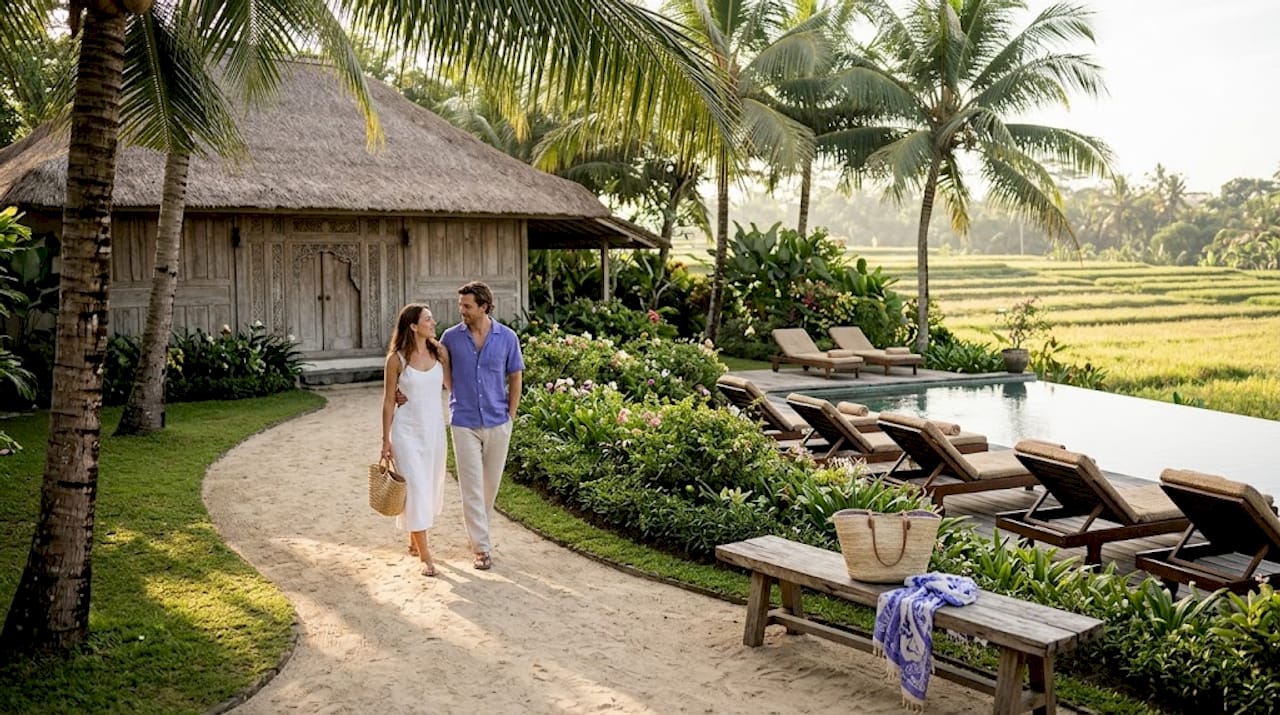
Bali’s lodging scene has grown into one of the most varied in Southeast Asia. Whether you’re traveling with kids, planning a surf trip, or looking for a week of yoga and silence, the types of Bali accommodations available today cover every style and price point imaginable. The island now boasts over 3,500 hotels and countless private properties, ranging from bamboo bungalows in the jungle to cliffside resorts above the Indian Ocean. Knowing the difference between each category before you book will save you from a costly mismatch between what you expect and what you actually get.
Table of Contents
- Key takeaways
- 1. Luxury resorts and five-star hotels
- 2. Managed villa complexes
- 3. Standalone private villas
- 4. Guesthouses and homestays
- 5. Boutique hotels
- 6. Surf camps and adventure lodges
- 7. Yoga retreats and wellness centers
- 8. Eco-friendly accommodations
- 9. Hostels and budget guesthouses
- 10. How to match your accommodation type to your trip
- My honest take on choosing Bali accommodations
- Experience Bali at its best with Casabriobali
- FAQ
Key takeaways
| Point | Details |
|---|---|
| Private villas lead for families | Villas offer privacy, kitchen access, and a home-like environment that hotels cannot replicate for groups. |
| Location shapes your entire trip | Seminyak and Canggu attract social travelers, Ubud suits wellness seekers, and Sanur fits calm family stays. |
| Budget options cluster in Kuta | Hostels and guesthouses in Kuta and Legian offer affordable beds with social perks and easy beach access. |
| Wellness stays require specific areas | Yoga retreats and eco-lodges are concentrated near Ubud, not in coastal resort zones. |
| Match your type to your travel purpose | Aligning your accommodation category to your trip goals prevents disappointment and overspending. |
1. Luxury resorts and five-star hotels
Bali’s luxury resort market is world-class in every sense. Properties in Seminyak, Nusa Dua, and along the Uluwatu cliffs deliver beachfront or oceanview settings alongside full-service spas, multiple restaurants, and pools that seem to pour into the horizon.
What separates genuine luxury from properties that just charge luxury prices comes down to personalization. Modern luxury travelers increasingly favor exclusivity and flexibility over the standardized hotel experience, and the best resorts in Bali have adapted accordingly. Expect butler service, bespoke excursion planning, and dining experiences tailored to dietary needs or celebration moments.
- Best for: Couples, honeymoons, special occasions, and travelers who want zero friction
- Average nightly rate: $250 to $1,000+
- Top locations: Nusa Dua, Seminyak, Jimbaran, Uluwatu
Pro Tip: Book directly with the resort rather than through a third-party platform. Many five-star Bali properties offer complimentary room upgrades or resort credits when you reserve through their official site.
2. Managed villa complexes
A managed villa complex sits between a private villa and a full-service hotel. You get your own freestanding unit with a private pool, but the property is run by a hospitality team. Managed villas offer 24/7 reception and concierge support, unlike standalone villas that rely on a private household staff with more limited hours.
These properties are popular in Seminyak and Canggu, where clusters of two to twenty villas share a management office, security, and sometimes communal facilities like a gym or beachclub access. For families who want independence without the logistical responsibility of a fully private villa, this format hits a practical sweet spot.
The tradeoff is that you share the compound with other guests. If the property has thin walls or a rowdy neighboring group, your experience suffers. Read recent guest reviews specifically for noise and privacy before committing.
3. Standalone private villas
This is the accommodation category that has genuinely changed how families and groups travel to Bali. Private villa preferences have surged because travelers want the privacy and home-like environment that no hotel corridor can offer. A standalone villa gives you a full property: private pool, living areas, kitchen, multiple bedrooms, and a dedicated staff that works exclusively for your group.
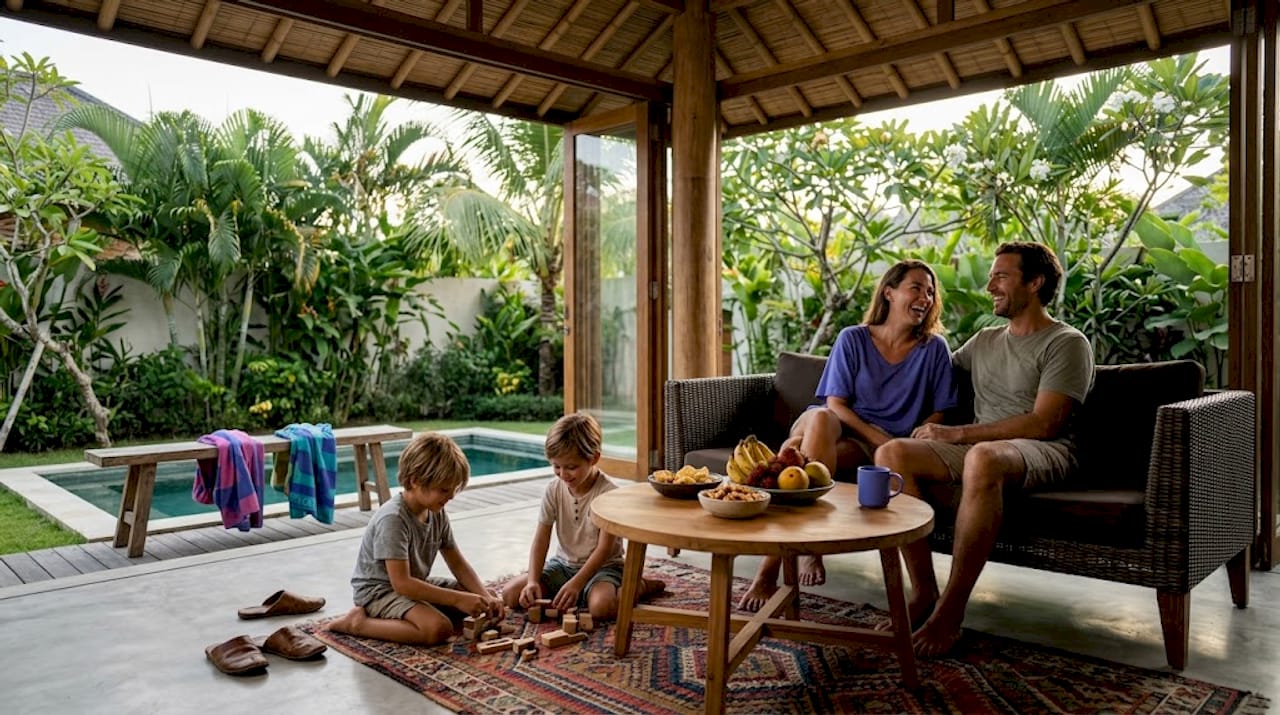
Pricing scales with bedroom count, location, and staffing level. A three-bedroom villa in Canggu with a pool and daily breakfast runs roughly $200 to $400 per night. A five-bedroom fully staffed property in Seminyak, closer to the premium end, sits higher but splits affordably across a large group. Rental yields on villas reach 5 to 15%, reflecting just how in-demand these properties remain year-round.
One practical caveat: many standalone villas sit at the end of narrow gang (laneways), and navigation apps are non-negotiable for finding them. Download offline maps and carry a local SIM or eSIM before you arrive.
Pro Tip: When considering villas for families, look for properties with a dedicated staff chef. The ability to request allergy-safe meals for children at any hour is genuinely life-changing compared to restaurant scheduling.
4. Guesthouses and homestays
Guesthouses and homestays are where Bali’s traditional hospitality roots are still clearly visible. A Balinese family-run guesthouse, known locally as a losmen, typically offers simple private rooms set around a garden or open-air pavilion. Breakfast is usually included. The hosts are often present, and many travelers report that these stays provide more genuine cultural insight than any resort can manufacture.
Ubud, Sanur, and the quieter village areas of Sidemen and Amed have high concentrations of quality guesthouses. Prices run from $25 to $80 per night for a private room with breakfast, making them one of the best budget stays Bali offers without sacrificing comfort entirely.
For solo travelers and couples who prioritize connection over amenities, this category delivers disproportionate value. You are living alongside local life rather than being insulated from it.
5. Boutique hotels
Boutique hotels in Bali occupy the space between a guesthouse and a mid-scale resort. They typically have ten to thirty rooms, a distinct design identity, and a focused concept. You will find properties built entirely from reclaimed teak in Ubud, surf-focused design hotels steps from the water in Canggu, and heritage Javanese architecture repurposed into intimate retreats near Seminyak’s back streets.
What boutique hotels do better than large resorts is atmosphere. The staff-to-guest ratio is higher, the food program is often curated by a single chef, and the design decisions feel intentional rather than corporate. For travelers who care about where they eat breakfast more than whether the property has a kids’ club, boutique is the right call.
Rates vary widely, from $60 to $300 per night. Location and the season are bigger pricing drivers than the quality of the experience, which stays consistently personal. For an overview of how Bali’s distinct areas shape your stay, the Casabriobali blog covers neighborhood-by-neighborhood breakdowns.
6. Surf camps and adventure lodges
Bali built its international reputation partly on surf. Kuta, Canggu, and Uluwatu continue to draw beginner through advanced surfers, and the accommodation ecosystem around them reflects that demand. Surf camps bundle lodging with board rental, daily lessons, and guided sessions at local breaks. For a first-time surfer visiting solo, this format compresses the learning curve dramatically.
- Typical inclusions: Daily surf lessons, board and wetsuit rental, breakfast and communal dinner, airport transfers
- Best locations: Kuta and Legian for beginners, Uluwatu and Canggu for intermediate and advanced surfers
- Nightly rates: $40 to $120, usually quoted as weekly packages
Adventure lodges, distinct from surf camps, cater to hikers targeting Mount Batur or Mount Agung, white-water rafters, and cycling groups. These properties prioritize early wake-up logistics and packed-lunch preparation over aesthetics. They are intensely functional and usually excellent at what they do.
7. Yoga retreats and wellness centers
Bali has become a global reference point for wellness-focused stays that integrate spa, yoga, meditation, and healthy dining into a single program. Ubud is the center of this world, though quieter areas like Sidemen and the north coast around Lovina have developed strong wellness options that attract travelers looking to avoid Ubud’s growing crowds.
A wellness retreat in Bali is not just a hotel with a yoga class on the schedule. The best properties build their entire daily rhythm around a guest’s physical and mental restoration: sunrise yoga, Balinese healing treatments, afternoon meditation, plant-based cooking classes, and guided sound bath sessions. Stays are often sold as five to ten day programs rather than nightly rates.
Pricing reflects the curated experience. Entry-level shared-room programs start around $100 per day all-inclusive. Private suite programs at premium retreats run $400 to $800 per day. The investment pays for structure, which is what most wellness travelers actually need.
8. Eco-friendly accommodations
Eco-lodges and sustainability-focused properties have grown meaningfully in Bali, driven by travelers who want their money to support rather than deplete the environment they came to experience. These properties use solar energy, harvest rainwater, source food from on-site gardens or local farms, and often participate in community programs.
The overtourism pressure in Kuta and Seminyak has pushed many eco-conscious travelers toward alternative regions like Sidemen, Munduk in the highlands, and the Bukit Peninsula’s quieter coves. Eco-lodges in these areas combine sustainability credentials with genuine scenery. You wake up to rice terrace views or jungle canopy rather than pool bars.
Amenities are intentionally modest compared to luxury resorts. Air conditioning may be absent in favor of natural ventilation. Showers may be cold. The trade-off is a connection to the natural environment that more polished properties actively engineer away.
9. Hostels and budget guesthouses
Bali’s hostel network is well-developed and increasingly comfortable. Hostels and budget guesthouses are concentrated in Kuta and Legian, where dorm beds cost as little as $8 to $15 per night and private rooms with air conditioning start around $20 to $35.
| Feature | Hostels | Budget Guesthouses |
|---|---|---|
| Privacy | Low (shared dorms) | Moderate (private rooms) |
| Social atmosphere | High | Low to moderate |
| Average nightly cost | $8 to $20 | $20 to $50 |
| Typical amenities | Pool, bar, communal kitchen | Room, fan or AC, breakfast |
| Best for | Solo backpackers, groups | Couples, budget-conscious families |
Modern Bali hostels are not the grim dormitories of a decade ago. Many have rooftop pools, social kitchens, organized pub crawls, and co-working spaces. The social dynamic is the main draw. If you are traveling solo and want to meet people, a good hostel does that better than any other accommodation type.
10. How to match your accommodation type to your trip
Knowing the types is useful. Knowing which type fits you is the part most travelers skip.
Your location choice in Bali fundamentally shapes your experience more than almost any other decision. Seminyak and Canggu deliver a social, restaurant-forward, nightlife-adjacent experience. Ubud gives you culture, art, and wellness. Sanur is calm and family-oriented. Uluwatu is for surfers and cliff-sunset seekers. Book the wrong type of accommodation in the right area and you will still have a good trip. Book the right accommodation in the wrong area for your goals and no amount of pool views will fix it.
| Traveler type | Best accommodation fit | Recommended area |
|---|---|---|
| Families with young kids | Private villa or family resort | Seminyak, Sanur |
| Solo backpackers | Hostel or surf camp | Kuta, Canggu |
| Couples on honeymoon | Luxury resort or boutique hotel | Uluwatu, Jimbaran |
| Wellness-focused travelers | Yoga retreat or eco-lodge | Ubud, Sidemen |
| Groups and celebrations | Standalone private villa | Seminyak, Canggu |
Pro Tip: Before you search by price, search by purpose. Write down the three things you most want from your Bali trip, then filter accommodation types by which category delivers those three things. You will book faster and with more confidence.
For group travel specifically, a Bali group travel checklist will help you map logistics, room configurations, and area tradeoffs before any deposits are paid.
My honest take on choosing Bali accommodations
I’ve spent a lot of time thinking about what actually makes a Bali stay memorable versus just expensive, and my conclusion surprises people: the accommodation type matters more than the budget level.
I’ve seen travelers drop serious money on five-star hotel rooms and feel oddly disconnected from the place they flew thousands of miles to reach. A private villa in the same price range, or even lower, gave them a base that felt personal, flexible, and genuinely Balinese. The villa’s staff cooked local food in the kitchen, the kids had space to run, and evenings happened around their own pool rather than a lobby bar.
What I’d tell any traveler today: resist the pull of the familiar hotel format just because it feels safe. Bali’s most rewarding accommodation types, especially private villas, homestays, and eco-lodges, require a small leap of confidence. That confidence gets repaid every morning when you wake up in a space that feels like yours.
I’d also push back on the instinct to cluster in the most popular areas. Overtourism in hotspots is real and growing, and the travelers who discovered Sidemen or Amed five years ago now consider that choice their best Bali decision. The accommodations are cheaper, the atmosphere is calmer, and the culture feels intact rather than curated for tourism.
Choose based on your travel purpose. Then choose a location that serves it. Everything else follows.
— Djani
Experience Bali at its best with Casabriobali
If your trip involves a group, a family, or simply a desire for space and privacy without sacrificing quality, Casa Brio in Seminyak deserves a serious look.

Casa Brio is a fully staffed, five-bedroom private villa in the heart of Seminyak, combining modern design with genuine Balinese warmth. The property includes a private swimming pool, rooftop terrace, and an open-sided pavilion built for both relaxation and celebration. Every detail, from the villa’s layout and living areas to the trained household team, is designed around guests who want the freedom of a private home with the care of a luxury hotel. Check current rates and availability to plan your stay in one of Seminyak’s most welcoming private retreats.
FAQ
What are the main types of Bali accommodations?
The main types include luxury resorts, managed villa complexes, standalone private villas, guesthouses, boutique hotels, surf camps, yoga retreats, eco-lodges, and hostels. Each category serves a different traveler profile and price range.
Which Bali accommodation type is best for families?
Private villas are generally the top choice for families because they offer dedicated staff, private pools, full kitchens, and the space for children to move freely without disturbing other guests.
What is the best area in Bali for first-time visitors?
Seminyak is the most practical base for first-timers, offering a mix of restaurants, beach clubs, and shopping with easy access to other areas. Families may prefer Sanur for its calmer atmosphere and gentler beach conditions.
How much does a private villa in Bali cost per night?
A private villa in Bali ranges from around $150 per night for a smaller property in a quieter area to over $1,000 per night for a fully staffed, multi-bedroom property in Seminyak or Uluwatu. Group size significantly affects the per-person cost.
Are eco-friendly accommodations worth choosing in Bali?
Yes, particularly if you want to explore less crowded regions like Sidemen or Munduk. Eco-lodges in these areas combine sustainability with genuine scenery and offer a more authentic experience than the heavily visited southern coastal zones.